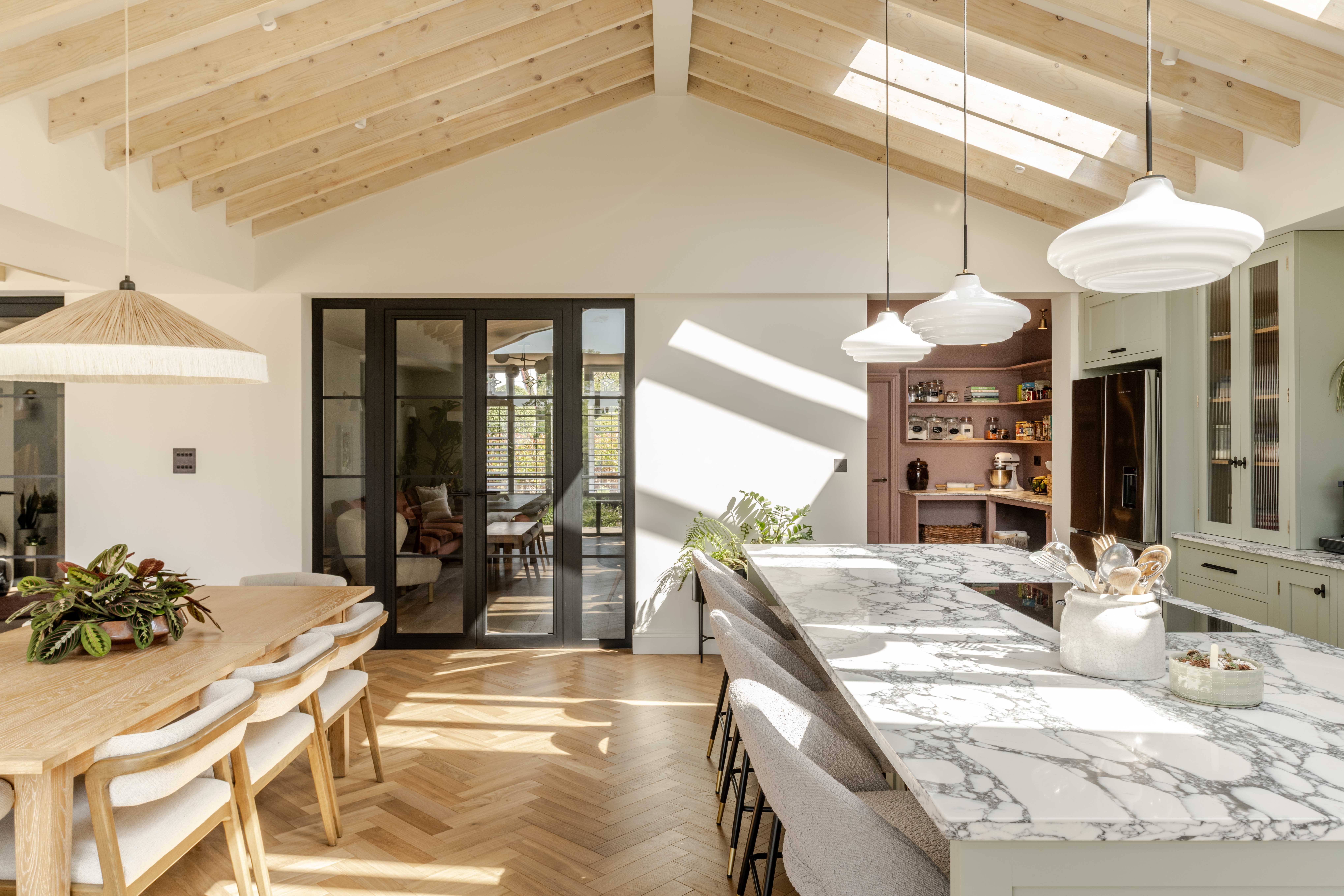
The full story behind what Extraordinary Extensions showed on Channel 4
Our South Croydon project was recently broadcast on Channel 4’s Extraordinary Extensions. It’s a house we’re very proud of, and you can see it as the first project on our projects page.
The programme did show that moment — the site standing empty, the panic of a stalled build — but a 45-minute episode can’t spend long on what came next: the practical, unglamorous work of actually fixing it. That’s the part most homeowners never see, on this project or any other.
It’s easy to assume an architect’s job is to draw something beautiful and then step aside once building starts. In reality, a large part of what we do becomes visible when a project runs into trouble — and that’s exactly what happened here. So here is the fuller account: what happened, what we actually did about it, and what it tells you about the value of having an architect in your corner throughout a build, not just at the drawing board.
The problem: your builder goes bust
Contractor insolvency is more common than most homeowners realise, and it is rarely something you see coming from the outside. One week there’s a full team on site; the next, progress slows, materials stop arriving, and calls go unanswered.
For a homeowner it is genuinely frightening. You have a partially built house, a half-spent budget, an unfinished contract, and no obvious idea who to call. Every week the site stands empty is a week of cost, risk and stress — and an exposed structure deteriorating in the weather.
What we did: a new builder, fast
The single most useful thing we were able to do was find our clients a replacement contractor quickly.
That wasn’t luck. It was the result of years of working with builders across South London and knowing, at any given moment, who is good, who is reliable, and who has capacity. When the call came, we already had a shortlist in mind and existing relationships to draw on. Instead of the client starting from a blank page — writing to unknown contractors found online, waiting weeks for site visits, and hoping the prices came back somewhere near sensible — we were able to get a capable builder to site and working in just 3 weeks.
Speed matters enormously here. A stalled site costs money even when nothing is happening: scaffolding hire, insurance, temporary accommodation, financing. A fast, well-managed handover to a new contractor is the difference between a setback and a disaster.
We also handled the practical mechanics of that handover: recording exactly what had been built, assessing what had been paid for versus what had actually been delivered, checking that materials already on site were secured, and preparing a clear package of information so the incoming builder could price the remaining works accurately rather than guessing and loading the price with risk.
What we did: reworking the specification to protect the budget
The second thing we did was go back through the specification line by line with the client.
When a project is disrupted, the budget almost always takes a hit. Rather than let that derail the design, we looked hard at where money was being spent and asked, in each case, whether it was buying something that genuinely mattered.
Some items came out altogether. Others we replaced with different products that achieved a very similar result for considerably less. Some things were deferred to a later date, to be done once the dust had settled.
This is the work people usually call “value engineering”, and it is much more than simply choosing cheaper things. The skill is in knowing which savings are invisible in the finished building and which ones you will regret every day for the next twenty years. Saving money on a concealed fixing, an alternative supplier, or a slightly different tile is sensible. Saving money by shrinking a window, downgrading insulation, or removing the one detail that gives a room its character is not — that’s just making a worse building for slightly less money.
Because we knew what the design was for, we could tell the difference. The finished house holds all the qualities the client originally came to us for, delivered within a budget that had to change.
What this means if you’re planning your own project
A few things we’d encourage any homeowner to think about:
- Choose your builder properly, and get help doing it. Tender the work to several contractors on the basis of the same information, so you’re comparing like with like. A price that is dramatically lower than the others is a warning, not a bargain. Ask for recent references and go and see the work.
- Use a proper building contract. For domestic work, something like a JCT Homeowner or Minor Works contract sets out payment stages, timescales, who carries which risk, and what happens if things go wrong. A quote on a single sheet of paper does none of this.
- Never pay ahead of the work. Pay for what has actually been built, valued honestly, with a modest retention held back until defects are made good. Requests for large advance payments are one of the clearest signs a contractor is under financial pressure.
- Watch for the early warning signs. Fewer people on site, deliveries drying up, suppliers chasing payment directly, and sudden pressure for money out of sequence are all worth taking seriously.
- Keep good records. Photographs, dated site notes, written instructions, and a clear paper trail of what was agreed and paid are invaluable if you ever need to appoint someone else.
The role of the architect
There’s a version of our profession that exists only at the drawing stage. It’s cheaper, and on a project where absolutely nothing goes wrong, you may not notice the difference.
But projects do go wrong. Contractors fail, ground conditions surprise everyone, prices move, and clients’ circumstances change. When that happens, what you need is someone who understands the design intent, understands construction and cost, holds the whole picture in their head, and is working for you rather than for the person doing the building.
That is what our clients in South Croydon had. It’s why their project is a finished house they love, rather than a cautionary tale.
Cherry Architects is a boutique architecture and interior design studio creating bespoke house extensions, refurbishments and new build family homes across South London and East Surrey.